
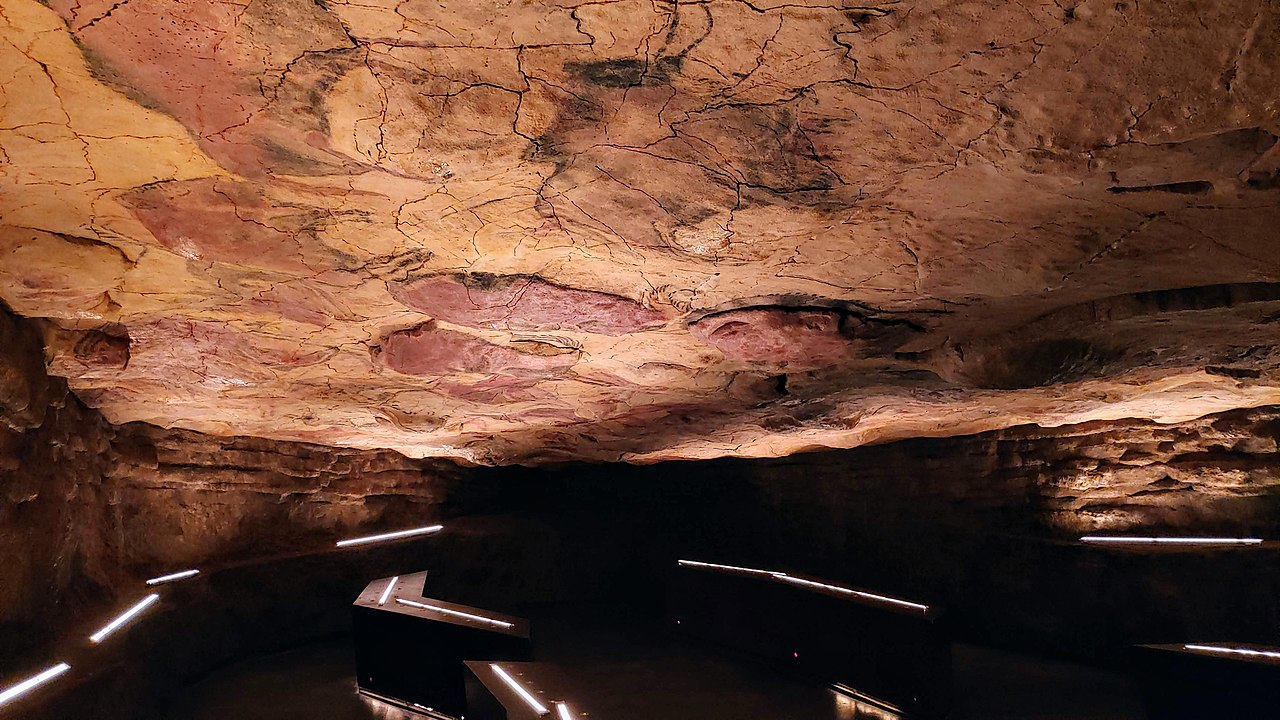
In the green hills of Cantabria, just two kilometres from the medieval town of Santillana del Mar, lies a cave that fundamentally changed our understanding of early human creativity. The Cave of Altamira, inscribed on the UNESCO World Heritage List since 1985, contains polychrome paintings of bison, horses, and other animals that are widely regarded as the finest examples of Paleolithic art ever discovered.
The Story of Discovery
The cave's entrance was first noticed in 1868 by a local hunter named Modesto Cubillas, who stumbled upon it while retrieving his dog from a rocky crevice. However, it was not until 1879 that the cave's artistic treasures were recognised. That year, amateur archaeologist Marcelino Sanz de Sautuola brought his eight-year-old daughter Maria to the cave during an excavation session. While her father worked at ground level, Maria looked up at the ceiling and exclaimed, "Look, Papa, oxen!"
What Maria had spotted was the cave's famous polychrome ceiling: a breathtaking panel of nearly life-sized bison, horses, deer, and other animals painted in red, black, and ochre pigments. Sautuola published his findings in 1880, attributing the paintings to the Paleolithic era. His claims were met with fierce scepticism from the academic establishment, and he died in 1888 without receiving recognition. It was not until the early 1900s, after similar discoveries in France, that the prehistoric origin of Altamira's paintings was universally accepted.
The Art of Altamira
The cave's artistic programme spans thousands of years, with works attributed to different periods of the Upper Paleolithic. The most celebrated section is the Great Ceiling (Gran Techo), a roughly 18-metre-long panel containing around 30 animal figures.
The Polychrome Ceiling
The Great Ceiling represents one of the supreme achievements of Paleolithic art. The artists exploited the natural bumps and contours of the rock surface to give their animals a three-dimensional quality that still astonishes viewers today. Each bison is rendered in multiple colours (red ochre, charcoal black, and yellow pigment), with careful shading that suggests an understanding of volume and form comparable to much later artistic traditions.
Radiocarbon dating has placed the polychrome paintings at approximately 14,500 years old, though some markings in other parts of the cave may date back as far as 36,000 years, potentially making them the work of Neanderthals rather than Homo sapiens.
Techniques and Materials
The Altamira artists used a surprisingly sophisticated range of techniques. Pigments were mixed with animal fat to create paints of varying consistency. Outlines were drawn with sharpened charcoal sticks, then filled with colour applied by fingers, leather pads, or rudimentary brushes made from animal hair. Engraving with flint tools added further detail to the figures.
Perhaps most remarkably, the artists appear to have worked by the light of stone oil lamps fuelled by animal fat and fitted with juniper wicks. Fragments of these lamps have been found within the cave, along with other tools of the trade including shells used as paint palettes and hollow bones through which pigment may have been blown onto the ceiling.
Why the Original Cave is Closed
Altamira was open to the public from 1917 until 1977, when the Spanish government ordered its closure after studies showed that the breath, body heat, and moisture generated by the roughly 175,000 annual visitors were causing visible deterioration of the paintings. Green algae had begun growing on painted surfaces, and changes in temperature and humidity were causing micro-fractures in the rock.
A limited reopening programme ran between 2014 and 2015, allowing small groups of five visitors to enter the original cave for 37 minutes under strictly controlled conditions. However, ongoing concerns about conservation led to the programme's suspension. As of 2025, access to the original cave is extremely restricted and available only through a periodic lottery system managed by the museum.
The Neocueva: Experiencing Altamira Today
In 2001, the National Museum and Research Center of Altamira opened the Neocueva (New Cave), a meticulous replica of the original cave built adjacent to the museum. Created using photogrammetric mapping and high-resolution scanning of the original chamber, the replica reproduces every contour, colour, and texture of the Great Ceiling with extraordinary fidelity.
Visitors to the Neocueva walk through a reconstruction of the cave's entrance and passages before arriving at the replica of the polychrome ceiling. Expert guides explain the artistic techniques, the materials used, and the cultural context of the paintings. The experience provides a vivid impression of what it would have been like to stand in the original chamber by the flickering light of a Paleolithic lamp.
The adjacent museum houses an excellent permanent exhibition covering the broader context of Paleolithic life in northern Spain, including tool-making techniques, subsistence strategies, and the spiritual dimensions of cave art. Interactive displays allow visitors to try their hand at some of the same techniques used by the original artists.
Practical Information for Visitors
Location
Museo Nacional y Centro de Investigacion de Altamira, 39330 Santillana del Mar, Cantabria, Spain. The museum is located about 2 km southwest of the town of Santillana del Mar.
Getting There
By car from Santander (30 km), take the A-67 motorway towards Torrelavega, then follow signs to Santillana del Mar. The museum has a large free car park. Buses run regularly from Santander and Torrelavega to Santillana del Mar, from where it is a 25-minute walk or short taxi ride.
Opening Hours
May-October: Tuesday to Saturday 9:30 AM to 8:00 PM, Sundays and holidays 9:30 AM to 3:00 PM. November-April: Tuesday to Saturday 9:30 AM to 6:00 PM, Sundays and holidays 9:30 AM to 3:00 PM. Closed Mondays, January 1, May 1, and December 24-25, 31.
Original Cave Access
Extremely limited. A lottery system occasionally selects five visitors per week for a 37-minute supervised visit. Registration is through the museum's official website. The Neocueva provides an excellent alternative experience for the vast majority of visitors.
Altamira in the Context of Spanish Cave Art
While Altamira is the most famous, it is far from the only cave with Paleolithic art in Spain. The northern coastal strip, known as the Cantabrian Cornice, contains dozens of decorated caves, many of which are included in the UNESCO inscription "Cave of Altamira and Paleolithic Cave Art of Northern Spain." Notable sites in the same region include El Castillo cave (which contains the oldest known cave art in the world, dating to at least 40,800 years ago), Tito Bustillo in Asturias, and Ekain in the Basque Country.
Together, these sites form one of the richest concentrations of Paleolithic art anywhere on Earth, reflecting the favourable living conditions and abundant natural resources that supported human populations along the Cantabrian coast during the last Ice Age. For visitors with a deep interest in prehistoric art, a multi-day tour of the region's caves provides an unparalleled opportunity to trace the development of human artistic expression over tens of thousands of years.